

Welcome to The Graphical, in which I mine the Opta data for insights as to how Nashville SC’s most recent result came about. You can also see more conventional game coverage from the Tampa Bay draw here at For Club and Country.
The big story
Tampa Bay got a lot of shots off Saturday evening. 25 of them, in fact! Nashville’s goal felt like it was constantly under attack. Let’s take a closer look at shot quality, though:
That’s a whole lot of missed shots (nine) and blocked shots (10). When you take into account that 19 of those 25 shots had no legitimate chance to score, it looks less like Tampa Bay’s offense dominated Nashville’s than that their style of play is to launch shots over and over again, hoping that sooner or later some of them go in. I don’t intend that as an insult, either: it’s a fun style of offense to watch, and with a bit more quality in the final third, it can lead to some huge scorelines.
That’s not to say Tampa didn’t control the run of play: they absolutely did. The Rowdies had 56.3% of possession, and those shots still count, even if the Rowdies didn’t make the most of them. But the stress for Nashville fans based on seeing the ball launched in the general direction of their goal is probably disproportionate to the actual odds of getting scored upon.
Let’s take another drilldown and look at shots outside the box. They’re inherently less likely to score than shots from closer to the goalmouth. That accounted for 13 of the 25 Tampa Bay shots, and ended with only three on target (again, with a lower chance of scoring even when they are on target, since the keeper has more time to react), one blocked outside the box and five blocked by defenders standing inside the penalty area (none made it into the six-yard box), and four completely off target. For the most part, those are the shots that the Nashville defense – with its well-earned trust in Matt Pickens – is designed to give up.
Is it better to rip a bunch of low-chance shots, or pass around looking for the perfect shot (often leading to no chance at all – we accused NSC of over-passing in the offensive third early in the year)? The beauty is in the eye of the beholder: in this one, obviously both methods ended up with a single goal.
Set piece party
A lot of Tampa Bay’s offense that didn’t come from hopeful shots outside of the box was the result of set pieces. Plenty of those shots (most of them missed, of course) at the top of the six-yard box were the result of corner kick service or free kick service – either directly or indirectly.
Thanks to the Rowdies’ taking of short corners or short FKs with an immediate cross (think the type of play that led to Liam Doyle’s goal against Charleston: since Lebo Moloto technically took the free kick, it’s not a FK goal for Doyle, though effectively it was), the exact graphs are hard to place together, but here’s a general picture:


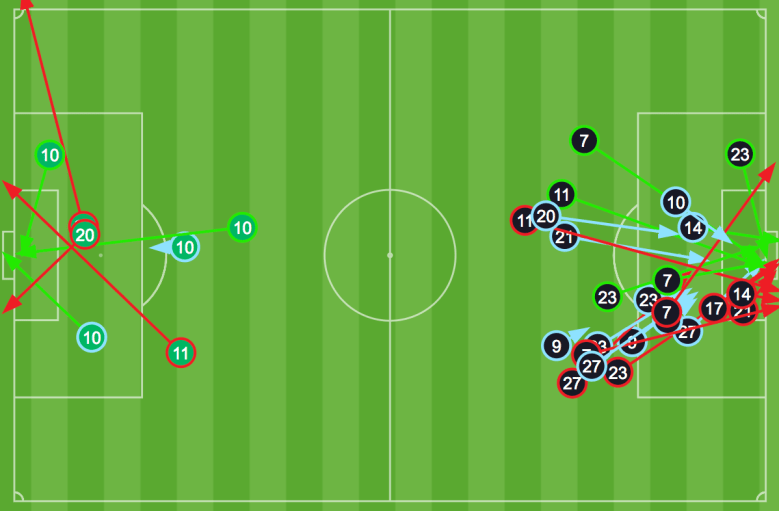
With 11(!!) corners, some of them take short and immediately crossed, there was a lot of opportunity for the ball to be played into the box. As we’ve previously discussed, playing crosses isn’t the most effective method of offense – and a bunch of missed shots inside the box speaks to that (many of those headed, though the graphs don’t point that out, either).
However, Nashville had trouble clearing on the first go, despite plenty of eventual clears, and that led to the game being played largely inside the NSC defensive penalty area:


If the ultimate result is just one goal against (and that on a somewhat unlucky play – after one of those many failed clearances), you can only complain so much… but at the same time, give up this many opportunities, let the ball be dictated on the opponents’ terms, and 1-1 results on the road are not going to be the most common outcome.
Goal chain
I’ll be breaking this play down in a Film Room post later in the week, but let’s take a look at the (short) possession that led to Nashville’s goal:
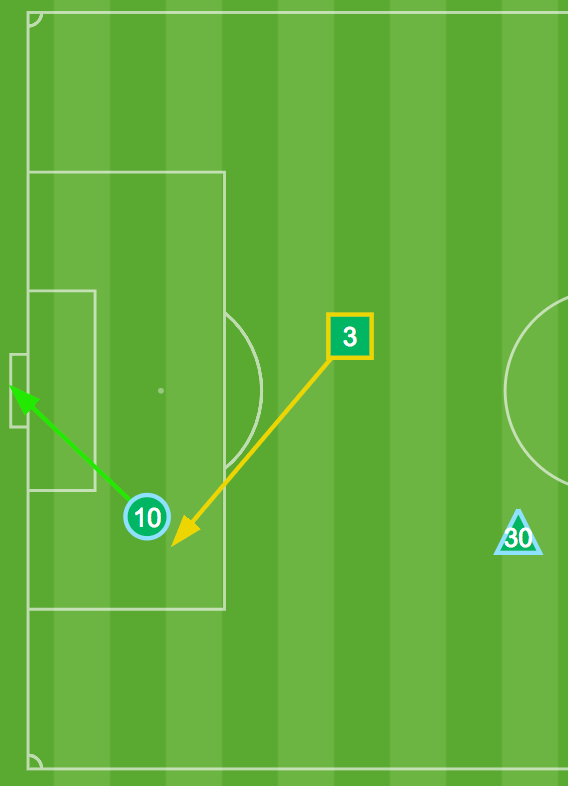
I’ve excised Akinyode’s (30) pass to Mensah (3) because it would cover up the loose-ball recovery that I think is key to the play. That pass hit Mensah about one touch short (to the right, in this graphic) of where he distributed to Moloto, who as you can see took just one touch before scoring himself.
This is quite a bit more direct play than we’re used to seeing from Nashville (in part because of the opportunity afforded by the turnover and transition play), and is yet another diversification of the ways in which the team can score. As mentioned countless times in the past on this website (or “obvious thing is obvious”), more options for scoring goals is better. The high press has paid off on this occasion, and the more we see it, the better NSC will be at not only executing it defensively, but quickly turning it into transition offense.
Thanks as always for reading FCAC. Please feel free to share our social media posts with a friend who is interested in in-depth coverage of Nashville SC.

 Club and Country