

It’s been a busy couple weeks locally, what with a string of six games in 16 days for Nashville SC reaching its conclusion this Saturday, plus two Men’s National Team games mixed into that stretch and a Women’s National Team contest against No. 17 China this evening. (Plus, less directly related to the scope of this site, the Champions League final right in the middle)
Still, that hasn’t stopped plenty of news from breaking (the MLS side named former Liverpool executive Ian Ayre as its CEO at the beginning of this crowded stretch, for example), and yesterday, the US Soccer Federation announced that former US international and current Philadelphia Union GM Earnie Stewart will be the general manager for the USMNT.
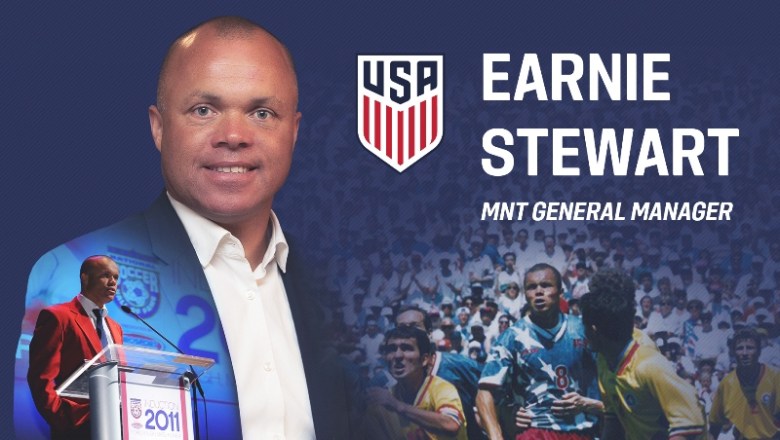
While there’s been plenty of controversy, clarification, etc. about the scope of the role, we can still take a look at Stewart’s history to try to figure out what sort of experience and skill he’ll bring to the position.
I’d recommend starting with American Soccer Now‘s fantastic look at his full post-playing resume. There’s a bit of a theme here:
Then at the start of the 2013/14 season, Stewart was part of yet another controversial decision. The club was off to a strong start. It qualified for the group stages of the Europa League and began the season in fourth place. The day after a 2-1 victory over Eredivisie leaders PSV in late September (which included a stunning goal from American Aron Johannsson), Verbeek was dismissed – despite a high level of success on the field. It was a decision the shocked many.
The club issued a statement that there was a “lack of chemistry” between the players and the coach and that was the reason for the abrupt dismissal. Stewart went into detail in a press conference.
He’d made managerial changes at previous clubs (despite success on the pitch) citing “culture” and “chemistry” as well. That’s clearly an emphasis for him – and given the reported issues surrounding such in the men’s national team in recent years, it may be wise to have somebody in the mix whose focus is on those areas.
There’s another aspect that certainly plays to my heart:
Before leaving AZ Alkmaar at the end of 2015, Stewart displayed willingness to think outside the box when he hired Billy Beane as an advisor. As an advisor of the general manager of the Oakland Athletics in Major League Baseball, Beane was famous for implementing “moneyball” tactics designed to use analytics to uncover overlooked talent at a lower cost.
More so than the specifics of hiring Beane, a willingness to do something that is considered outside of the traditional conventional wisdom of what works in the sport is a positive. Even if it doesn’t work out (after all, see the link above – Jürgen Klinsmann was a master of thinking outside the box, but not with positive results at all times), an intellectual flexibility is a positive. Especially for a country outside of the traditional world powers, being unconventional can be a path to overcoming institutional disadvantages.
His most recent gig, as mentioned at the top, was as Technical Director for the Philadelphia Union. The results on the pitch have been uneven (as is tradition in the short history of Philly, but it’s worth noting he hasn’t been a total game-changer for the positive), but there are some signs of positives in developing talent.
Let’s shift from the ASN story to a local take on his tenure with the Union. Brotherly Game fills us in. The primary angle of Stewart’s tenure certainly plays into what the USMNT will need.
Stewart oversaw the team as its institutional vision took shape: the club would rely heavily on the youth academy while augmenting that with shrewd acquisitions of external talent. Whether or not you agree with that vision, that’s what happened – to a degree.
German and Mexican dual-nationals aside (with occasional players eligible for other countries also), acquisition of new talent is not the method for the United States to succeed on the pitch. It’s about identifying, recognizing, and developing players from an existing talent base. Hiring a man who’s been in charge as an MLS team shifts into a “development over acquisition” gameplan is good.
Stewart had other positives, such as opening the world-class Power Training Complex and seeing the team make the playoffs in 2016. He was dedicated to the organization and hosted town hall meetings with the fans. But he also was insular, keeping even the smallest bits of information from the press until he deemed it time to release it.
As a journalist, the second part is annoying professionally but in terms of how it relates to the quality of the product his teams put on the pitch, probably neutral at-worst. The positives listed aren’t going to really relate to the USMNT gig.
As a player, Stewart (a Netherlands dual-national himself, so maybe the recruitment aspect will be more refined than his history gives us opportunity to evaluate) plied his trade mostly in the first and second divisions in the Netherlands. He is the top-scoring American in Europe with 111 club goals – and he also added four for DC United in a couple years toward the end of his career. Internationally, his 101 caps and 17 goals rank him No. 15 and in a three-way tie (with DaMarcus Beasley and Michael Bradley) for ninth all-time in United States history.
A great player, and I’ll say a strongly positive executive in the club world (and with more than 2.5 years in Philly, we’d have a much clearer view overall). How it applies to a semi-nebulous role as GM of the men’s national team is a question that can’t be answered directly from the curriculum vitae: we’ll have to see what happens with him in charge. Hiring a new head coach will be the first test.

 Club and Country