

Welcome to The Graphical, in which I mine the Opta data for insights as to how Nashville SC’s most recent result came about. You can also see more conventional game coverage from the Louisville win here at For Club and Country.
The big story
Hey, so Louisville dominated possession against Nashville Sunday. Don’t believe me? Look at the official numbers:

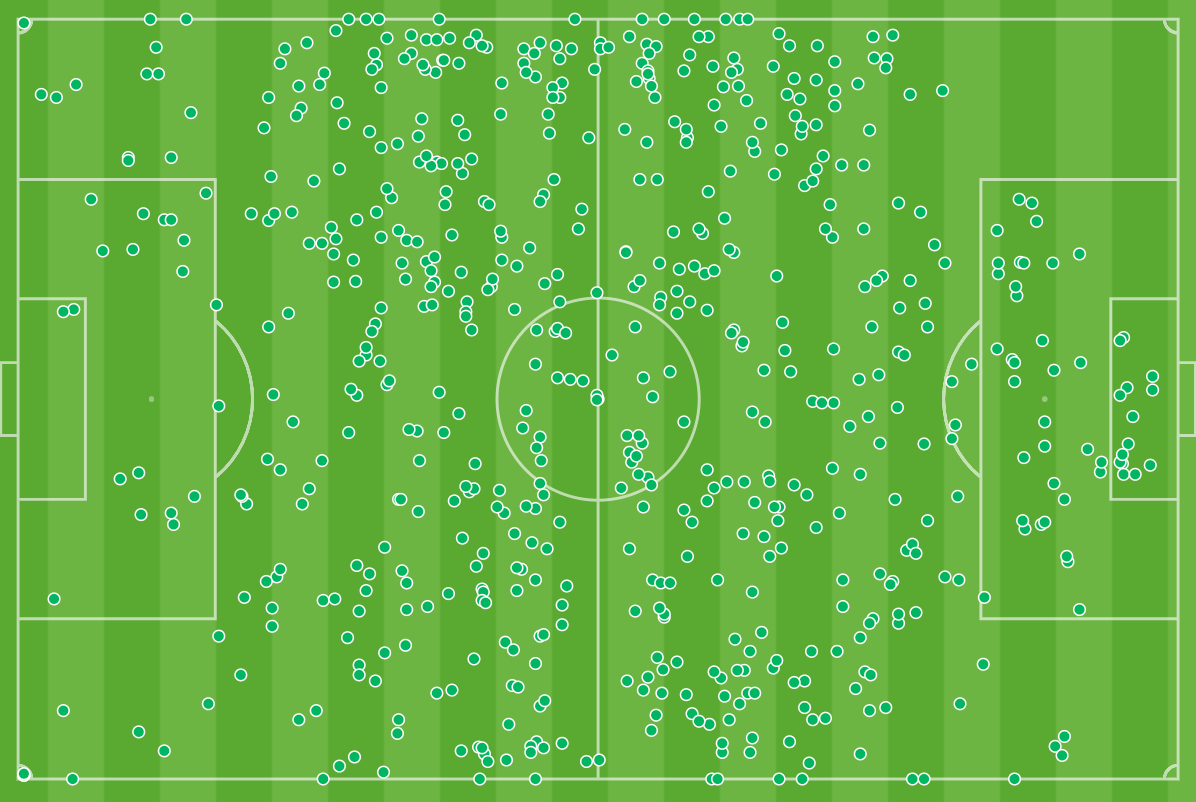
It actually looks even more stark when you consider where that possession took place. Louisville was rarely buried in its own end (even though Nashville pressed high a bit), and spent plenty of time entering the attacking third. LCFC is moving right-to-left here:

That touchmap features… not a whole lot in the defensive third – indeed, most of their possession in their own defensive half (outside of keeper Greg Ranjitsingh) starts along a razor-marked line that represents the neutral portion of the field – and enough touches in the attacking zone (including 20 in or on the edge of NSC’s penalty area) that they should have done better.
Of course, while soccer is a game of possession, and understanding possession helps us know how a game transpired, that’s not where games are won and lost. Let us not forget the essence of the game…

You have to score to win the game. Which brings us to…
Scoring chances
Even here, Louisville was about even, if not at an advantage. They earned five corners to Nashville’s one, used striker Cameron Lancaster () as a headed threat en route to a 60/40 advantage in aerial duels won, and took 13 shots to Nashville’s 11. That’s a recipe for outscoring the other team more often than not.
The look for Nashville gets a heck of a lot prettier (even before considering “two went into the net while none of theirs did”) when you look at the shot chart, though:

The Boys in Purple took nine shots outside the penalty area. Nashville settled for just five (with Moloto’s first goal right on the borderline). Even when only shots on-target are considered, there’s a maximum conversion rate of .13 xG (expected goals, which essentially boils down to the probability a given shot goes in) on shots from outside the box. Meanwhile, that jumps to .27 xG when you consider all shots inside the box. There’s variability within those two categories, of course, but a shot inside the box is, on average, twice as good as one outside the box – over-simplifying here, but the point remains the same.
That Louisville was only able to put four shots on the target, with three of them coming from outside the box, and there’s no surprise they were unable to find the back of the net. Meanwhile, Nashville put seven on the frame, five of them from within the penalty area, and it feels almost like an inevitability (NSC’s recent finishing struggles aside) that they were able to find the back of the net.
Let’s look at one more thing before moving along. Those shots that are signified with a blue circle, and a blue arrow emanating from it? Those are blocks. Nashville defenders (not keeper Matt Pickens) blocked three Louisville shots, two of them from relatively dangerous areas inside the box. The only blocked shot suffered by NSC was on a long-range shot by Lebo Moloto.
That says volumes about Nashville’s team defense. We shouldn’t be surprised at this point that the Boys in Gold are elite defensively – and not just because of an outstanding keeper in Pickens – but that’s an effort indicator that is just another piece of evidence in confirmation.
Akin-good-e
Still workshopping that pun, folks
I think it’s fair to say that Bolu Akinyode’s performance against New York Red Bulls II (his first professional club) was one of his worst. He graded out poorly, his lack of quick tracking back defensively led to some of NYRBII’s most dangerous chances, his passing was conservative but still led to some giveaways, etc. There are reasons for some of that against the style and talent in New York, but the performance is the performance in the end.
Hell of a way to bounce back this week. Here’s his passing chart, including every incomplete pass:

“But Tim, you left out the incompletions,” you say. “Ah ha!” I respond, “there weren’t any of them!”
He covered the whole width of the field – as both central defensive midfielders are tasked with doing in this version of the 4-4-2 – the lengths and directions of these passes are some of Akinyode’s most ambitious of the year, and he completed. every. one. That’s a nice day, folks.
He committed three fouls, but they were all in the offensive half of the field (in a high press, not committing fouls in dangerous positions for his team’s defense). He made three loose-ball recoveries and an interception in the offensive half, and made a solid tackle on the edge of his own box without conceding a foul. That’s a real nice day.
The assists
Wrapping up with another happy item, Nashville’s assists on the day. Here they are in graphical form:

That’s Ropapa Mensah’s No. 3 covered up by Michael Reed’s No. 17, for those who don’t recall.
I do want to say something specific about these assists: they both, to a large extent, created the goals that ultimately resulted from them. Each shot was a first-touch (Moloto’s first, from Mensah’s cross, was a right-footed blast, while his second, on the cross from Reed, was a header) finish.
That hasn’t always been the case for NSC this year: on their five goals prior to Sunday’s win, the team had been credited with three assists (Mensah’s steal-turned finish against NYRB and Michael Cox’s penalty kick against Bethlehem the lone exceptions), but not all of them were so direct when it came to creating the goal.
Alan Winn cut back to his left and beat a defender after Kosuke Kimura’s assist against Charlotte Independence, Ropapa Mensah took a touch then boxed out a defender after Pickens’s assist in the same game. Mensah’s tally against Indianapolis – a toe-poke after a cutback cross from Moloto – was the only of the three to be a first-touch finish.
If you’re keeping score, that means of Nashville’s first three goals, none were pure creations of the distributor. Of the four since, all but one was primarily created by the distribution. That’s not to say it’s inherently better (in fact, I’d say it’s not) to be able to create first-touch scoring, but to be able to do both that and have players who can create a goal with the ball at their feet – with or without service from a teammate – increases the number of avenues through which NSC can score.
As time goes on, a wider availability of methods to score means more opportunities to get on the board going forward, and ultimately better scoring output.
Thanks for taking a deeper look at Nashville’s performance. Is there something that jumped out to you poking around the data? Feel free to share in the comments or get to me on Twitter or Facebook (and follow those outlets while you’re there!).

 Club and Country