

Always trying out new features. In The Graphical, I dig into the Opta data to learn a bit about how a result came about.
So, Tuesday’s game was hardly a thriller. A couple nice saves (from each team), but not a whole lot of threat around the goalmouth… at least not much that turned into legit chances.
Shoot your shot
Nashville had one shot at point-blank range saved, and its other two shots on target were from outside the box. Another shot inside the box was blocked, and two more were off-frame. Meanwhile, Penn took a bunch of very low-percentage shots, and the only two on-target were free-kick strikes saved by Matt Pickens.

You can see that Nashville was far more dangerous – more accurate, shooting from better positions – despite fewer overall shots. Pickens will take that shot by No. 29 at the edge of the six-yard box or that from No. 4 at the opposite edge any day of the week. Nashville was also closer to having many more legitimate threats on goal. The pass juuuuust out of the reach of Robin Shroot in the 36th minute springs to mind, for example.
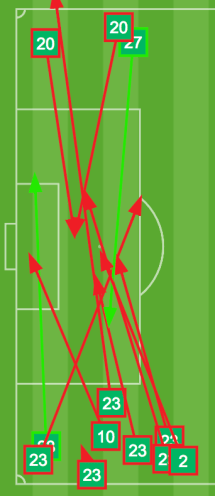 That play is included in the chart on the right (all of Nashville’s attempted crosses in the game, including both successful ones). The cross is an inherently low-percentage play, in a lot of ways: by definition, the ball has to get past or over one or multiple defenders on the vast majority of them. Still, the Shroot video linked above indicates that a lot of the red arrows in this image were a heck of a lot closer to being completed passes (and therefore possession in the box, even if they weren’t all going to develop into a shot on goal) than perhaps you might think when the word “cross” comes to mind. This wasn’t a fullback lobbing it hopefully in from the wing, so much as it was essentially a laced pass that the forward needs to get a boot on.
On that note, I’m not quite sure how Opta differentiates between a low cross and a simple pass, because they can look the same (I would classify Washington’s feed that just missed Shroot as much the latter as the former). Anyway, the positions of these crosses – not far from the edges of the box, and deep on the pitch (close to the endline) are the most dangerous positions to get a cross off. Again, we’re perhaps seeing that Nashville is just going to end up a team that spoils a lot of good chances. It’s at least as likely with so little data to this point in the season that simple bad luck has struck a few times. The sample size is low.
Shroot your shot
Speaking of the player who couldn’t get onto Washington’s cross, Robin Shroot was a bit of a surprise inclusion in the starting lineup, not because of his presence on the field, but rather where he lined up: right wing. He’s an out-and-out striker, but after a cameo appearance on the wing at the end of the Indy game, his last two appearances have come there. How does his movement compare to those who also play the position? Let’s look at not just this game, but the past two:


Shroot (left) and Matt LaGrassa (right) both played right wing in this game (Shroot was subbed off at 69′). It’s worth noting that when LaGrassa came on, NSC had to be pushing for a late winner, so the fact that he didn’t get into the box at all is a little troubling. However, in much less time on the field, look how much more spread along the sideline his movement is. That’s a matter of pace, and a matter of movement. Shroot is more a goal-getting striker, used to crafty movement, rather than workrate, to create his chances. I think that shows here (as does the tendency to float centrally, since that’s where he’s more used to playing).
Here’s the heatmap of Shroot compared to that of Alan Winn in the Indy Eleven match:


They’re on opposite sides of the field (Taylor Washington flipped from an inverted winger on the right to crossing winger on the left when Winn was subbed off for Shroot at 79′), but this time, Shroot’s positioning should have the benefit of the team absolutely needing to nick a game-tying goal in the final minutes. He didn’t seem to work forward into dangerous offensive positions either to create his own shots or to get in crosses. The lateral range of Winn’s movement, the vertical stretch up the sideline, and thew knack for getting into dangerous positions in the box is a game-changer.
None of this is to say Shroot doesn’t belong on the field (you’ll recall when he signed that I liked his ability as a pure goal-getter), but rather that maybe the wing isn’t the best fit for him. When deploying Shroot on the wing also means you take a player – Winn – whose speed is a game-changer in itself off the pitch, I have a hard time finding much to like about it.
With a four-man midfield (and especially late in games when NSC is trying to push for a winner), taking one of the central defensive midfielders (Bolu Akinyode or Michael Reed) off the pitch in favor of inserting Shroot as a playmaking attacking midfielder makes sense. In that role, he can interchange at forward with Lebo Moloto, since both are capable of playing truly up top or lying deeper while the other one pushes forward. It allows you to keep speed on the wing and stretch horizontally (even if Winn’s not on the field, I think LaGrassa has the pace to play out there situationally, and depending on who’s starting in central midfield, the personnel doesn’t have to change too much because he can just shift outside), while putting a little more playmaking up top.
A third section that doesn’t have “shot” in the title
One final look at Tuesday’s graphs here. I was critical of the center referee during the contest, and remain so: he was well out of his depth as a USL official, at least in this one-game sample size. Lebo Moloto’s yellow-carded offense was almost certainly deserving of a red, and Robin Shroot’s might have been. Bradley Bourgeois’s yellow was hilarious over-officiating: there was minimal contact beyond shoving a guy (who had just blasted Bourgeois’s keeper in a yellow-carded offense) out of the way.
Nashville had conceded an average of 13.0 fouls in its first five games, and conceded 19 in this one. That’s not too far out of the realm of possibility to simply chalk up to a game that’s just chippy both ways, right? It’s the team’s responsibility to adjust to a tight whistle. However, look at the locations of the fouls given up:

The locations are just bad luck, or a Penn team getting into the positions it wanted, and drawing legitimate fouls (certainly the majority of these calls are legit). Maybe they’re a ref who’s drawn to calling fouls at a certain angle. Regardless, it’s on Nashville to adjust. With the whistle tight in Nashville’s offensive and defensive ends of the field – while a better defender in Robin Shroot is on the pitch – Nashville couldn’t afford to put Winn on.
Indeed, when Shroot came off, LaGrassa (again, primarily a central defensive midfielder earlier in the year) replaced him: the backline needed more cover than you can expect out of Winn, unfortunately. Both of Penn’s shots on goal are accounted for in the foul graphic: one from the half-covered No. 30 (Akinyode-committed foul), the other from the No. 10 (Moloto-committed foul), both about 10 yards outside the edge of the box. Giving more defensive responsibility to the defenders and CDMs by putting Winn on the field would have been really tough.
Again, that’s not to say there was any malice or bias on the part of the official (Hanlon’s Razor and all, plus Nashville ended up with the better end of the bad calls overall), but the specifics of when and where the fouls were being called necessitated tactics that prevented the best offensive lineup from hitting the field.
Thanks for reading The Graphical. Don’t forget to follow For Club and Country on Twitter and Facebook to get all the Nashville SC news and analysis you desire.

 Club and Country